- Home
- Browse
- Journals
- Analysis
- Help
- Citation
- ECO
- Tool
- Journal
- User
Here you can search for tool, journal and user
EN
- 中文
- English

contact us

SAAMBE-SEQ
SAAMBE-SEQ: A sequence-based method for predicting mutation effect on protein-protein binding affinity
ID:36335Uploader:BioTreasury
2022.01.19
8

Collect
Collect
Like
Like
DetailComments (0)
Abstract
Motivation: Vast majority of human genetic disorders are associated with mutations that affect protein-protein interactions by altering wild-type binding affinity. Therefore, it is extremely important to assess the effect of mutations on protein-protein binding free energy to assist the development of therapeutic solutions. Currently, the most popular approaches use structural information to deliver the predictions, which precludes them to be applicable on genome-scale investigations. Indeed, with the progress of genomic sequencing, researchers are frequently dealing with assessing effect of mutations for which there is no structure available. Results: Here, we report a Gradient Boosting Decision Tree machine learning algorithm, the SAAMBE-SEQ, which is completely sequence-based and does not require structural information at all. SAAMBE-SEQ utilizes 80 features representing evolutionary information, sequence-based features and change of physical properties upon mutation at the mutation site. The approach is shown to achieve Pearson correlation coefficient (PCC) of 0.83 in 5-fold cross validation in a benchmarking test against experimentally determined binding free energy change (ΔΔG). Further, a blind test (no-STRUC) is compiled collecting experimental ΔΔG upon mutation for protein complexes for which structure is not available and used to benchmark SAAMBE-SEQ resulting in PCC in the range of 0.37-0.46. The accuracy of SAAMBE-SEQ method is found to be either better or comparable to most advanced structure-based methods. SAAMBE-SEQ is very fast, available as webserver and stand-alone code, and indeed utilizes only sequence information, and thus it is applicable for genome-scale investigations to study the effect of mutations on protein-protein interactions. Availability and implementation: SAAMBE-SEQ is available at http://compbio.clemson.edu/saambe_webserver/indexSEQ.php#started. Supplementary information: Supplementary data are available at Bioinformatics online.
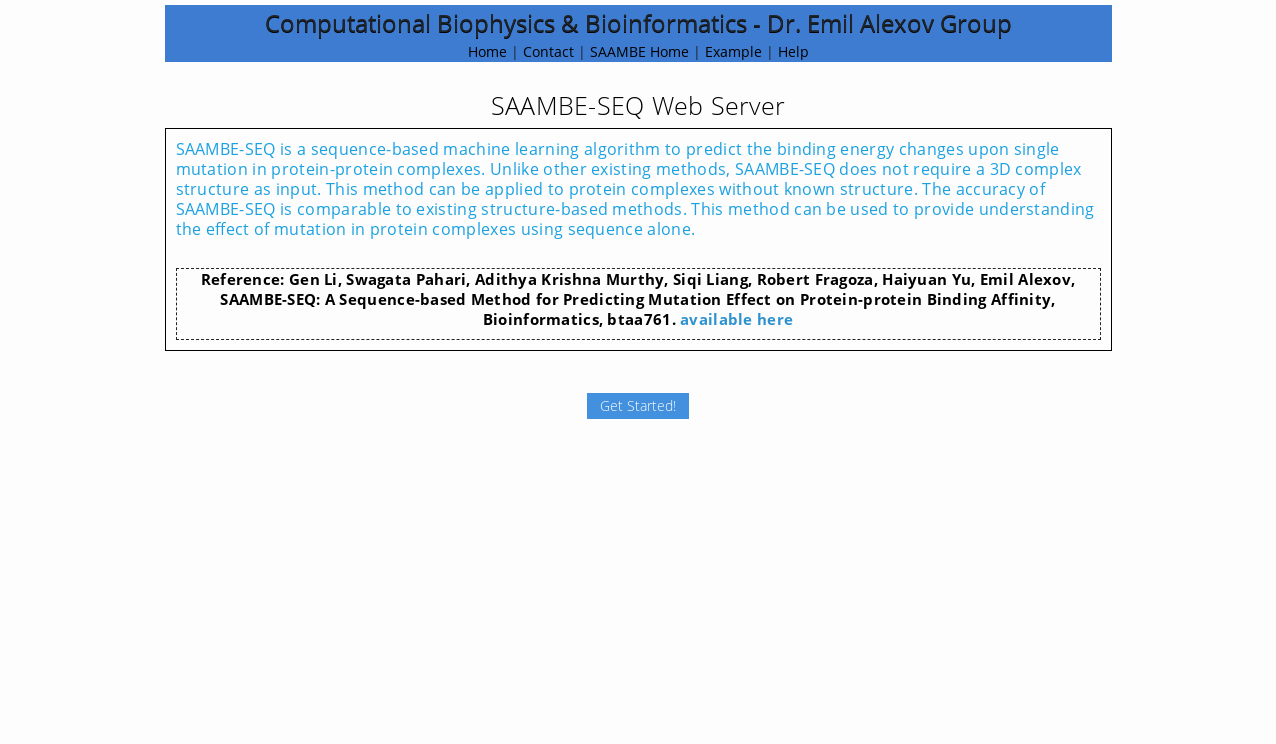
Screenshot
Publication
SAAMBE-SEQ: a sequence-based method for predicting mutation effect on protein–protein binding affinity
Gen Li,Swagata Pahari,Adithya Krishna Murthy,Siqi Liang,Robert Fragoza,Haiyuan Yu,Emil AlexovBioinformatics. 2020
Cited by 36 articles
The RESP AI model accelerates the identification of tight-binding antibodies
Jonathan Parkinson, Ryan Hard, Wei Wang Nature Communications. 2023
Sequence-based machine learning method for predicting the effects of phosphorylation on protein-protein interactions
Xiaokun Hong, Jiyang Lv, Zhengxin Li, Yi Xiong, Jian Zhang, Hai-Feng Chen International Journal of Biological Macromolecules. 2023
MPA-MutPred: a novel strategy for accurately predicting the binding affinity change upon mutation in membrane protein complexes
Fathima Ridha, M Michael Gromiha Briefings in Bioinformatics. 2024
Implications of disease-related mutations at protein–protein interfaces
Dapeng Xiong, Dongjin Lee, Le Li, Qiuye Zhao, Haiyuan Yu Current Opinion in Structural Biology. 2021
Application of Proteogenomics to Urine Analysis towards the Identification of Novel Biomarkers of Prostate Cancer: An Exploratory Study
Tânia Lima, António S. Barros, Fábio Trindade, Rita Ferreira, Adelino Leite-Moreira, Daniela Barros-Silva, Carmen Jerónimo, Luís Araújo, Rui Henrique, Rui Vitorino, Margarida Fardilha Cancers. 2022
Aggregate score

Citations

Altmetric
Ratings
No ratings
Check update
Tag
Proteins & Proteomes
Protein sites, features and motifs
Protein interactions
Operating system
The tool doesn't have any operating system information yet.
Author
The author has not claimed it yet

 Search